

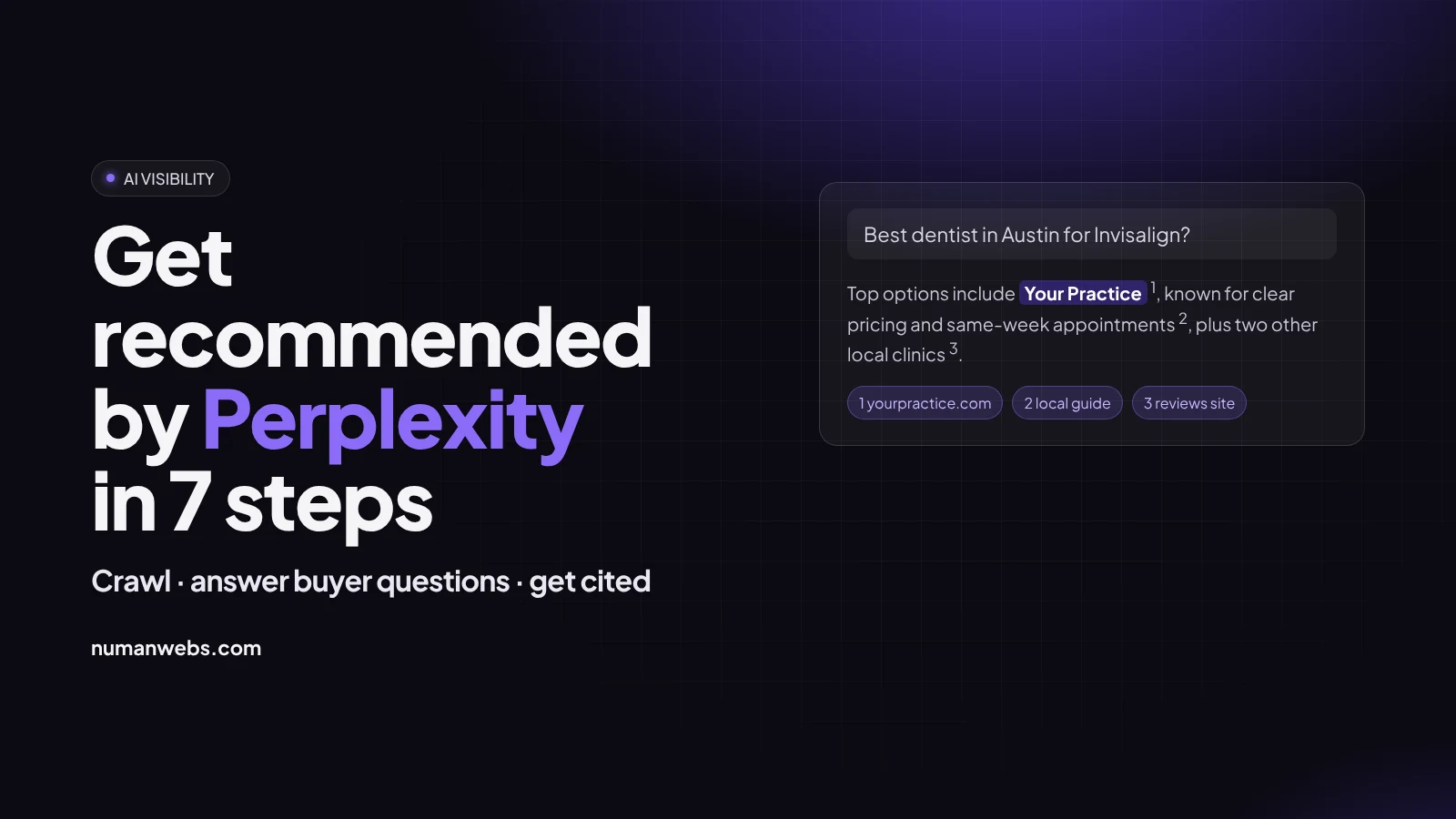
Short answer: to get your business recommended by Perplexity, make sure Perplexity’s crawler can read your site, publish pages that answer the exact questions buyers ask (“best [service] in [city]”, “[service] cost”), and get mentioned on the sites Perplexity cites as sources. Perplexity shows its sources next to every answer, so the goal is simple: be one of those sources, or be named by them.
In this guide:
- How Perplexity picks which businesses to recommend
- The 10-minute test: does Perplexity know you?
- 7 steps to get recommended by Perplexity
- Perplexity vs ChatGPT: what’s different
- How long it takes
- FAQ
How Perplexity picks which businesses to recommend
Perplexity is an answer engine. It searches the web, reads a handful of pages, and writes an answer with numbered citations.
That changes the game for a small business. You don’t need to “train” anything. You need to be on the pages Perplexity reads when someone asks about your kind of business.
In practice, those pages fall into three groups:
- Your own site, if it clearly answers the question and the crawler can read it.
- Lists and directories: “best of” articles, local guides, review sites and industry directories.
- Discussions: forum threads, Q&A pages and news mentions that name you.
If none of those pages mention you, Perplexity has nothing to recommend. If several do, and they agree on what you do and where, you become an easy answer.
The 10-minute test: does Perplexity know you?
Before fixing anything, check where you stand. Open Perplexity in a private window and run these prompts:
- “Best [your service] in [your city]”
- “[Your business name] reviews”
- “How much does [your service] cost in [your city]?”
- “[Your business name] vs [main competitor]”
For each answer, note three things: are you named, which sources are cited, and is the information about you correct?
The cited sources are your to-do list. Those are the exact pages Perplexity trusts for your market.
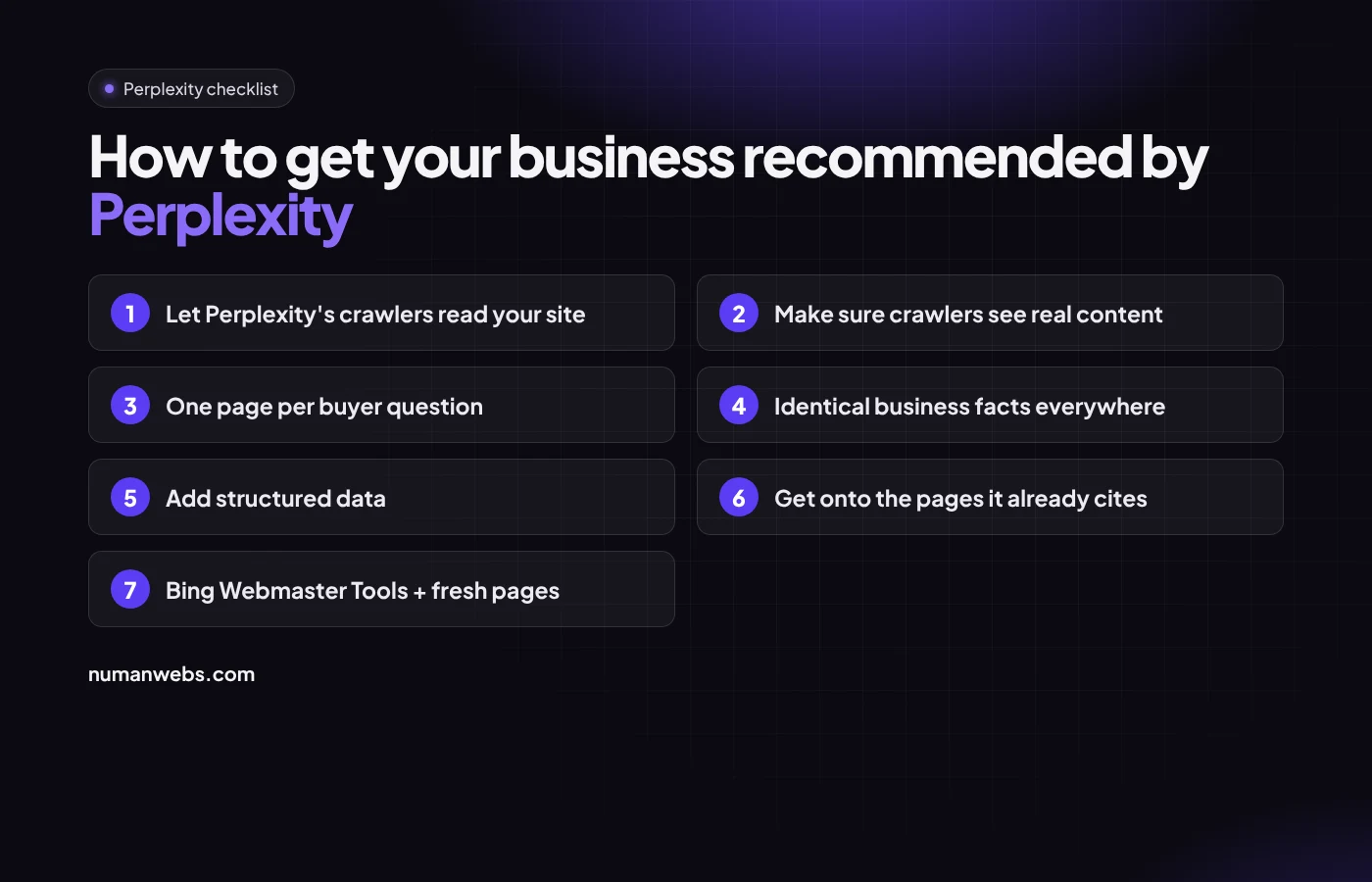
7 steps to get recommended by Perplexity
1. Let Perplexity’s crawlers read your site
Perplexity lists its crawlers in its official crawler documentation. PerplexityBot is the one that finds and links websites in Perplexity’s search results, and Perplexity-User visits a page when someone asks a question so Perplexity can link to it in the answer. Check that your robots.txt allows PerplexityBot, and that no firewall or “bot protection” setting blocks either of them.
This matters more than people think. Some security plugins and CDN settings block AI crawlers by default, and the owner never knows.
2. Make sure the crawler sees real content
Many sites built with Lovable, Bolt or v0 send crawlers an almost empty page and load the text with JavaScript later. A person sees a full site; a crawler may see a blank one.
Quick check: view the page source (not the inspector) and search for your main headline. If it isn’t there, read our guide on why AI-built websites don’t show up on Google. The same fix helps Perplexity.
3. Publish one page per buyer question
Perplexity quotes pages that answer the question directly. A homepage that says “We deliver excellence” answers nothing.
Write pages like:
- “[Service] in [city]”: what you do, who for, area covered, price range.
- “How much does [service] cost?”: real ranges and what changes the price.
- “[Option A] vs [option B]”: honest comparisons buyers already search for.
Start each page with a two-sentence answer, then the detail. That’s the part most likely to be quoted.
Example: a dental practice in Austin with one “Services” page listing eight treatments gives Perplexity very little to work with. Split it into pages such as “Invisalign in Austin”, “Emergency dentist in Austin” and “How much do dental implants cost in Austin?”. Open each one with a plain answer: who the treatment is for, how long it takes, the price range and which neighbourhoods you serve. Now, when a patient asks Perplexity “who does Invisalign in Austin?”, there is a page that answers that exact question, written by you, with your name on it.
4. Keep your business facts identical everywhere
Name, address, phone, services and opening hours should match on your site, Google Business Profile, Bing Places, Yelp and industry directories.
When sources disagree, AI tools hedge or skip you. When they agree, you’re a safe recommendation.
5. Add structured data
Mark up your business with LocalBusiness (or a more specific type, such as Dentist or MedicalClinic), plus FAQPage on question pages. Google’s structured data guide explains the format.
Structured data won’t get you recommended on its own, but it removes guesswork about who you are and what you offer.
6. Get onto the pages Perplexity already cites
Go back to your 10-minute test. For each cited “best of” list or directory:
- Claim or update your listing.
- Ask happy customers for reviews on that platform.
- Pitch the author of a local list with a short, factual note about what you do.
This is the highest-leverage step for Perplexity local business searches, because local answers lean heavily on these lists.
7. Register with Bing Webmaster Tools and keep pages fresh
Submit your sitemap in Bing Webmaster Tools as well as Google Search Console. More indexes that know your pages means more ways for answer engines to find them.
Then update key pages when prices, services or results change. A visible “last updated” date helps readers and machines trust the page.
Perplexity vs ChatGPT: what’s different
Most of the work overlaps. A few things differ:
| Perplexity | ChatGPT | |
|---|---|---|
| How it answers | Searches the web for its answers | Mixes trained knowledge with web search |
| Sources shown | Numbered citations on every answer | Links shown when it searches |
| Fastest lever | Get on the pages it already cites | Consistent facts + pages answering buyer questions |
| Crawler to allow | PerplexityBot | OAI-SearchBot |
If you’ve already worked through how to get your business recommended by ChatGPT and Claude, you’re most of the way there. If ChatGPT ignores you too, start with the 9 most common reasons.
How long it takes to get recommended by Perplexity
Because Perplexity searches the web for its answers, changes can show up faster than in tools that rely on training data. A fixed page can be read the next time it’s crawled.
Earning mentions on third-party lists takes longer, usually weeks to months. For a real example of the full process, see how two clinics reached #1 in ChatGPT. One of them, Pain Center of Rhode Island, also reached #1 in Google’s AI answer for “top pain management specialists in New England” within a 3-month project. The same groundwork carries over to Perplexity.
Re-run your 10-minute test once a month and keep a simple log of which prompts name you.
FAQ
Can I pay to be recommended by Perplexity?
No. Recommendations in Perplexity answers come from the sources it finds. The way in is to be on, or named by, those sources.
Does Perplexity use Google or Bing results?
Perplexity runs its own crawler and search system. Being well indexed in both Google and Bing still helps, because the same pages that rank there tend to be the ones worth citing.
Why does Perplexity show my competitor and not me?
Usually because your competitor appears on the pages Perplexity cites (lists, directories, reviews) and you don’t, or because your own site doesn’t answer the question clearly. Check the cited sources and close the gap.
Should I block AI crawlers to protect my content?
If you want to be recommended, no. Blocking PerplexityBot means Perplexity can’t read your pages, so it can only describe you from what others say.
Want Perplexity and ChatGPT to recommend you?
We’ll check what Perplexity and ChatGPT say when someone asks for your service in your area, see whether you’re named, and send you a short list of what’s stopping it. It’s free and there’s no call needed.
AI Visibility is our monthly service for businesses that want to be recommended by ChatGPT, Claude, Perplexity and Google: the crawl and content fixes, buyer-question pages, consistent listings and a monthly report. See AI Visibility.
Get your free AI visibility check → We reply within 1 hour.
About the author: Numan Habib is the founder of numanwebs, a web design and AI SEO studio in Lahore, Pakistan, working with clients worldwide. He has launched 233+ websites and helps small businesses get found on Google and recommended in AI answers.