
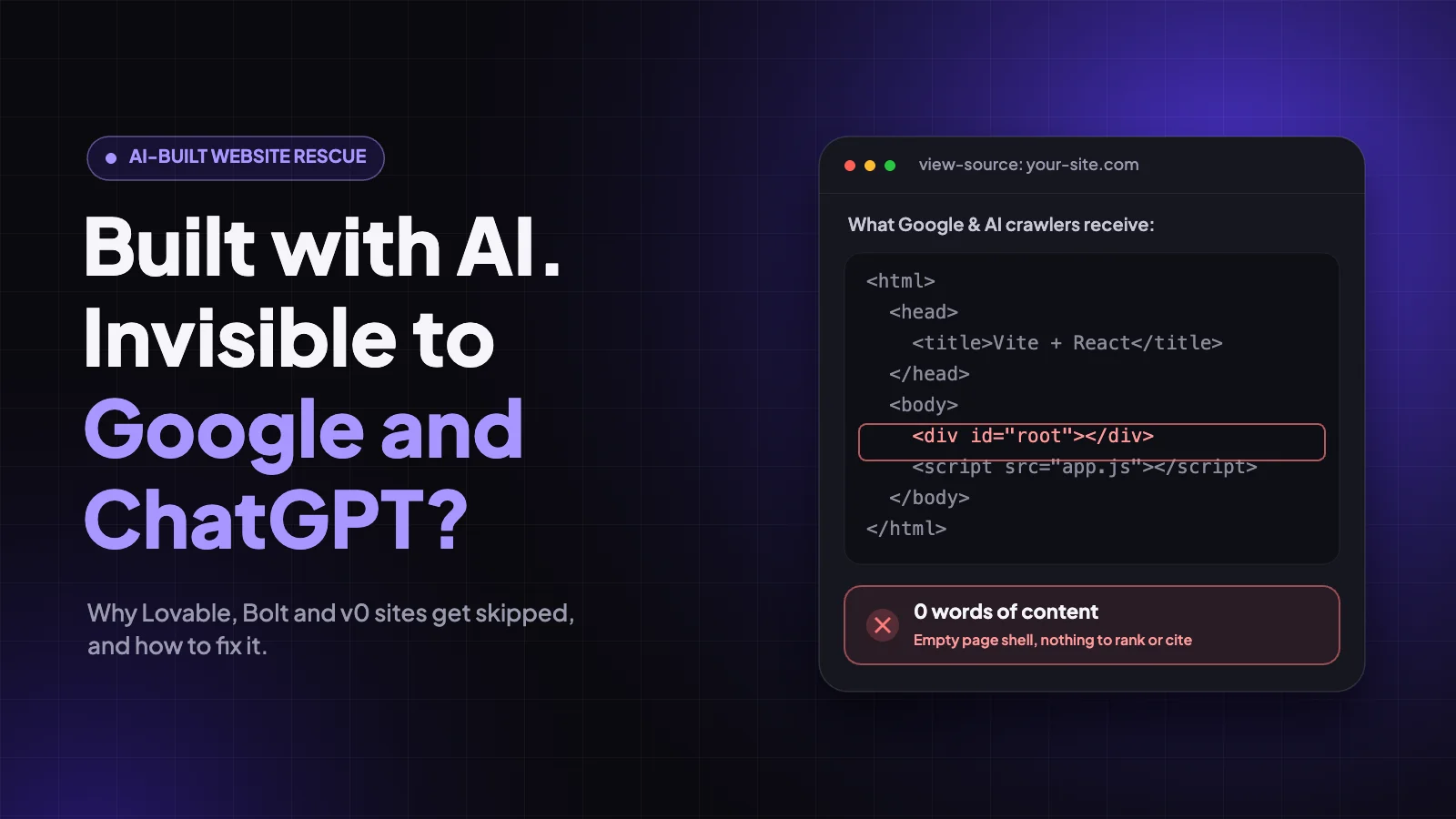
Short answer: most websites built with Lovable, Bolt, v0 or Replit look perfect in a browser but send search engines an almost empty page. They are built as JavaScript apps that assemble the page inside the visitor’s browser. Google can eventually render that JavaScript, slowly and not always reliably, but the crawlers behind ChatGPT, Claude and Perplexity don’t run JavaScript at all, so they see nothing to rank or recommend. Add the usual setup gaps (no sitemap, the same title on every page, no custom domain) and the site stays invisible. The good news: it’s fixable, usually in under a week.
The 2-minute test: can search engines see your site?
- View the page source. Open your homepage, right-click and choose View Page Source (not Inspect). Search for a sentence from your page. If all you find is something like
<div id="root"></div>and a script tag, crawlers that don’t run JavaScript see an empty page. - Turn off JavaScript. In Chrome DevTools, disable JavaScript and reload. What’s left is roughly what ChatGPT’s and Claude’s crawlers see.
- Search Google for your site. Type
site:yourdomain.com. If few or none of your pages show, Google hasn’t indexed them. - Check Search Console. In Google Search Console, the Pages report often shows AI-built sites stuck on Discovered – currently not indexed. The URL Inspection tool shows the HTML Google actually rendered.
Why AI-built sites are invisible: client-side rendering
A traditional website (WordPress, Framer, Webflow) sends finished HTML: your headings, text and links are in the page from the start. Many AI builders instead generate a single-page app: the server sends an empty shell plus a JavaScript bundle, and the visitor’s browser builds the page. This is called client-side rendering.
That causes three problems:
- Google indexes slowly. Google renders JavaScript in a second, delayed step. For a new site with no authority, pages can sit unindexed for weeks.
- AI assistants can’t read you. Industry testing, including a large study by Vercel, found that the crawlers used by ChatGPT, Claude and Perplexity fetch your page but don’t execute its JavaScript. If your content only appears after JavaScript runs, you can’t be cited or recommended. Google’s Gemini is the exception, because it uses Google’s renderer.
- Every page looks the same. Titles, descriptions and social previews often stay identical across all pages, because they’re only changed by JavaScript after load.
Which AI builders have this problem?
| Builder | What it usually outputs | Risk |
|---|---|---|
| Lovable (projects before mid-May 2026) | React + Vite single-page app, client-side rendered | High |
| Lovable (newer projects) | TanStack Start with server-side rendering | Low for rendering, but setup and content still matter |
| Bolt.new | Client-side rendered React app by default | High |
| Replit and similar app builders | Usually client-side rendered React | High |
| v0 by Vercel | Next.js, which can render on the server | Lower, depends on how it’s exported and hosted |
Builders change fast, so always run the 2-minute test on your own site instead of relying on what the tool promises.
7 other reasons your AI-built site isn’t ranking
- It’s still on the builder’s subdomain. A site on a lovable.app or similar address, or one that’s published on both a subdomain and a custom domain, splits signals. Pick one custom domain and redirect everything else to it.
- No sitemap or Search Console. Without a submitted sitemap, Google has to discover pages on its own. Add a sitemap.xml and submit it to Google Search Console and Bing Webmaster Tools.
- The same title and description on every page. Each page needs its own title and meta description in the HTML the server sends.
- No real headings or text. AI-generated layouts often use generic headings like “Welcome” and very little copy. Search engines need clear text about what you do and where.
- Links that aren’t real links. Buttons that navigate with JavaScript instead of normal
<a href>links stop crawlers from finding your other pages. - Blocked crawlers or a leftover noindex. Check robots.txt and meta tags. A setting left on from development can hide the whole site.
- Slow loading. Large JavaScript bundles delay the moment content appears, which hurts Core Web Vitals and rankings on mobile.
How to fix it: 3 options
1. Prerendering (quickest patch)
A prerendering service creates a finished HTML copy of each page and serves it to crawlers, while visitors still get the app. It can be set up without rebuilding, but it’s another monthly tool to manage, and it doesn’t fix weak titles, thin content or missing structure on its own.
2. Switch the project to server-side rendering
If your builder offers server-side rendering (newer Lovable projects do, and v0 uses Next.js), moving to it means every visitor and crawler gets real HTML. Older projects may need a careful migration.
3. Rebuild on an SEO-ready platform (best long-term)
For a business site that depends on Google and AI traffic, moving the design to WordPress, Framer or a server-rendered Next.js site removes the problem for good and gives you proper SEO tools, a CMS for your blog and schema support. You keep the look; you lose the invisibility.
Whichever route you take, finish with the basics: unique titles and descriptions, one clear H1 per page, a sitemap in Search Console and Bing, internal links, and answer-first content. Our guides on getting recommended by ChatGPT and Claude and why ChatGPT isn’t recommending your business cover the next steps.
Frequently asked questions
Why is my Lovable site not showing on Google?
Older Lovable projects are client-side rendered React apps, so crawlers can receive an almost empty page. Other common causes are the site not being published on a custom domain, no sitemap in Google Search Console, the same title on every page, and thin content. Lovable projects created from mid-May 2026 use server-side rendering, which removes the biggest problem.
Can ChatGPT and Claude read JavaScript websites?
Mostly no. Testing by Vercel and others found that the crawlers behind ChatGPT, Claude and Perplexity download pages without running JavaScript, so content that only appears after JavaScript runs is invisible to them. Google is the exception, because it renders JavaScript.
How do I check if Google can see my AI-built website?
Open your page, right-click and choose View Page Source. If you can’t find your headings and paragraphs in the source, crawlers can’t see them either. You can also use the URL Inspection tool in Google Search Console and look at the rendered HTML.
Do I need to rebuild my Lovable or Bolt site?
Not always. A prerendering service can serve crawlers a finished HTML copy of each page. For a business site that depends on search traffic, moving to a server-rendered platform such as WordPress, Framer or Next.js is usually the most reliable long-term fix.
How long does it take to fix an AI-built website for SEO?
Rendering and indexing fixes usually take 3 to 7 days. After that, Google typically recrawls and starts indexing pages within days to a few weeks.
Want us to rescue your AI-built site?
Our Rescue service fixes Lovable, Bolt and v0 sites that aren’t showing on Google: indexing and rendering fixes, speed and form fixes, hosting and CMS setup, and migration if needed. $399 fixed price, live in 3 to 7 days. See all pricing.
Send us your site for a free check → We’ll tell you what Google and AI crawlers can see today and the quickest way to fix it. We reply within 1 hour.
About the author: Numan Habib is the founder of numanwebs, a web design and AI SEO studio in Lahore, Pakistan, working with clients worldwide. He builds fast websites for small businesses and rescues AI-built sites that search engines can’t see.