

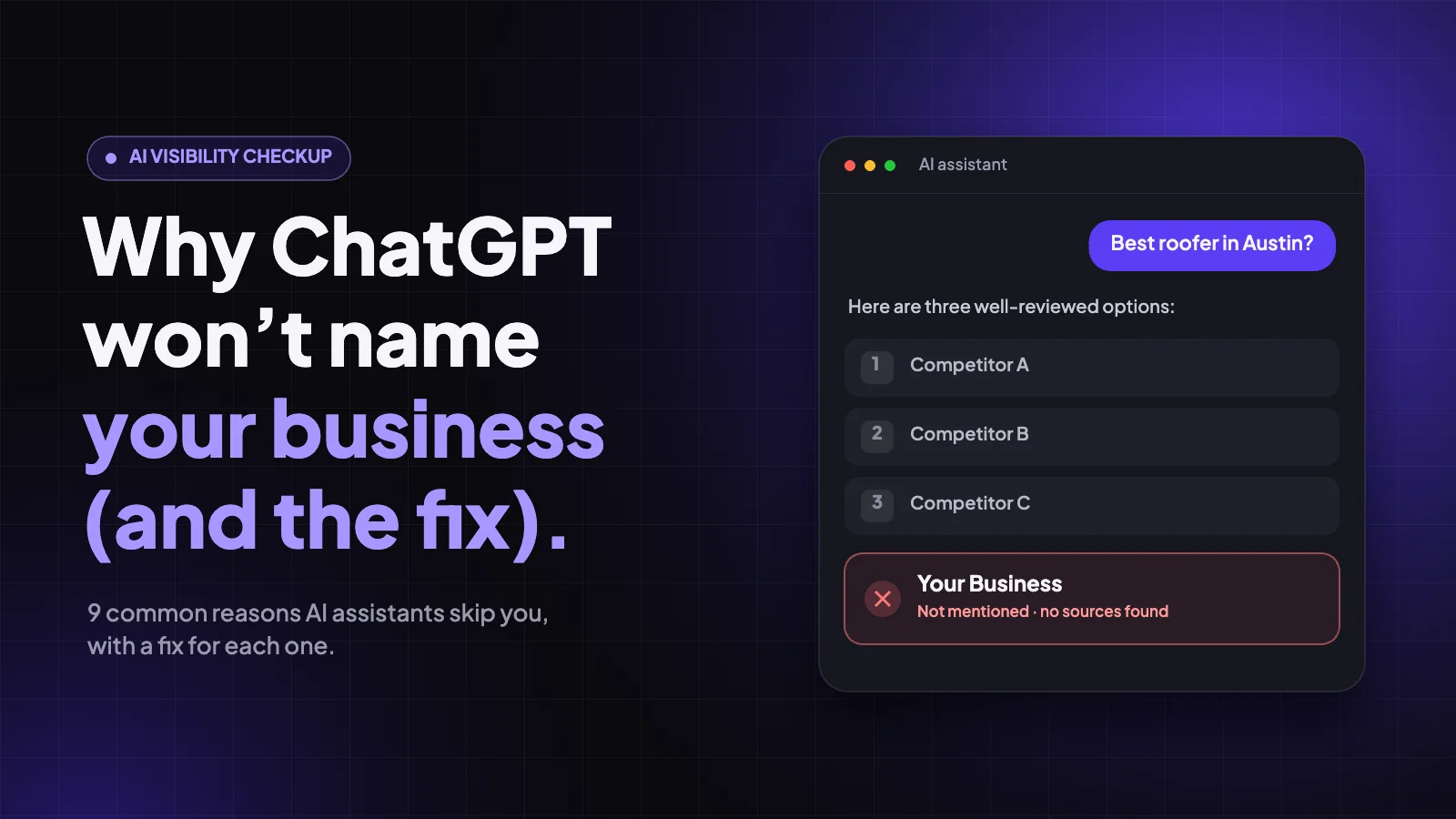
Short answer: ChatGPT recommends businesses it can find and trust. If it never names yours, the cause is usually one of nine fixable problems: your site isn’t in the search index ChatGPT uses, AI crawlers are blocked, your pages don’t clearly say what you do and where, your content is too thin to quote, or there isn’t enough evidence about you on other trusted sites. Work through the checklist below and you’ll know exactly what’s holding you back.
First, see what AI says about you today
Before fixing anything, open ChatGPT, Claude, Gemini and Perplexity and ask the exact questions your customers ask, such as “best dentist in Leeds” or “affordable web designer for a bakery”. Write down who gets named and which websites are cited as sources. Those cited pages are your real competition, and they show you what AI considers trustworthy in your market.
9 reasons ChatGPT isn’t recommending your business
1. Your site isn’t indexed in Bing
ChatGPT’s web search draws on Bing’s index alongside OpenAI’s own crawler. Plenty of small businesses rank on Google but have never been checked in Bing, which leaves them missing from a big part of ChatGPT’s source pool.
Fix: Verify your site in Bing Webmaster Tools, submit your sitemap and switch on IndexNow so new pages are found within minutes.
2. AI crawlers are blocked
Some hosts, security plugins and CDNs block unfamiliar bots by default. If OAI-SearchBot, PerplexityBot or similar crawlers can’t read your pages, those assistants can’t cite them.
Fix: Check your robots.txt and firewall rules, and allow the search crawlers of the AI tools you want to appear in.
3. A hidden noindex tag
A single setting left on from development can hide an entire website. When we started work with The Luna Clinic, the whole site was set to noindex and only 2 of 48 pages were on Google.
Fix: Inspect your key pages in Google Search Console and Bing Webmaster Tools, and remove any stray noindex tags.
4. Your website doesn’t say what you do and where
Slogans like “solutions that inspire” give an AI model nothing to match. If a customer asks for an emergency plumber in Bristol and your homepage never says “emergency plumber” or “Bristol”, you’re unlikely to be named.
Fix: State your service, your customer and your location plainly in page titles, the main heading and the first paragraph of each key page.
5. All your services are crammed onto one page
AI assistants answer specific questions. One general page can’t be the best answer to ten different questions.
Fix: Give each core service its own page with real detail: who it’s for, what’s included, price range, timeline and FAQs.
6. Thin or vague content
Pages with a few lines of text rarely get cited. Assistants prefer passages that answer a question directly and completely.
Fix: Open each page with a one- or two-sentence direct answer, then add detail. Use real customer questions as headings and include concrete facts like prices, areas served and turnaround times.
7. No structured data
Schema markup tells machines exactly what your business is, where it is and what it offers. Without it, engines have to guess.
Fix: Add LocalBusiness (or a more specific type), Service and FAQPage schema, and test it with Google’s Rich Results Test.
8. Not enough evidence on other sites
AI assistants trust what others say about you more than what you say about yourself. Few reviews, inconsistent directory listings or no mentions in your industry make you look like a risky recommendation.
Fix: Collect reviews steadily, keep your name, address and phone number identical everywhere, list your business in reputable directories, and earn links from relevant local and industry sites.
9. Your site is slow or hard to read
Heavy pages, content hidden in sliders or tabs, and sites built with AI app builders that render everything in JavaScript can be hard for crawlers to read.
Fix: Keep important text in plain HTML, compress images, and use caching and a CDN. If your site was built with Lovable, Bolt or v0 and isn’t showing up, our Rescue service fixes exactly this.
Quick checklist
- Verified in Google Search Console and Bing Webmaster Tools
- No noindex tags on important pages
- AI search crawlers allowed in robots.txt and firewall
- Service and location in titles, headings and opening lines
- One detailed page per core service
- Answer-first content and FAQs
- LocalBusiness, Service and FAQPage schema
- Consistent listings, recent reviews and relevant links
- Fast pages with text crawlers can read
For the full step-by-step playbook, read how to get your business recommended by ChatGPT and Claude.
Frequently asked questions
Why doesn’t ChatGPT mention my business?
Usually because it can’t find enough clear, trustworthy information about you. Common causes are pages that aren’t indexed in Bing, vague website copy, missing location details, few reviews or mentions on other sites, and blocked AI crawlers.
How do I check if ChatGPT recommends my business?
Ask ChatGPT, Claude, Gemini and Perplexity the questions your customers would ask, such as “best [service] in [city]”, and note which businesses are named and which websites are cited. Repeat monthly with the same questions to track progress.
Can I submit my business to ChatGPT?
There is no form to submit a business to ChatGPT. You can make sure your site is indexed in Bing, which ChatGPT search draws on, and that OpenAI’s search crawler, OAI-SearchBot, is not blocked.
How long until ChatGPT starts recommending my business?
Technical fixes such as indexing can help within weeks. Content and reputation improvements usually take three to six months to show up consistently in AI answers.
Want us to find out why AI is skipping you?
We’ll check how your business shows up in ChatGPT, Claude, Gemini and Google AI, and tell you exactly what’s holding you back. It’s free, and we reply within 1 hour. Ongoing work is covered by our AI Visibility plan at $299/month.
Get a free AI visibility check →
About the author: Numan Habib is the founder of numanwebs, a web design and AI SEO studio in Lahore, Pakistan, working with clients worldwide. He builds fast websites for small businesses and helps them rank on Google and get recommended by AI assistants.