
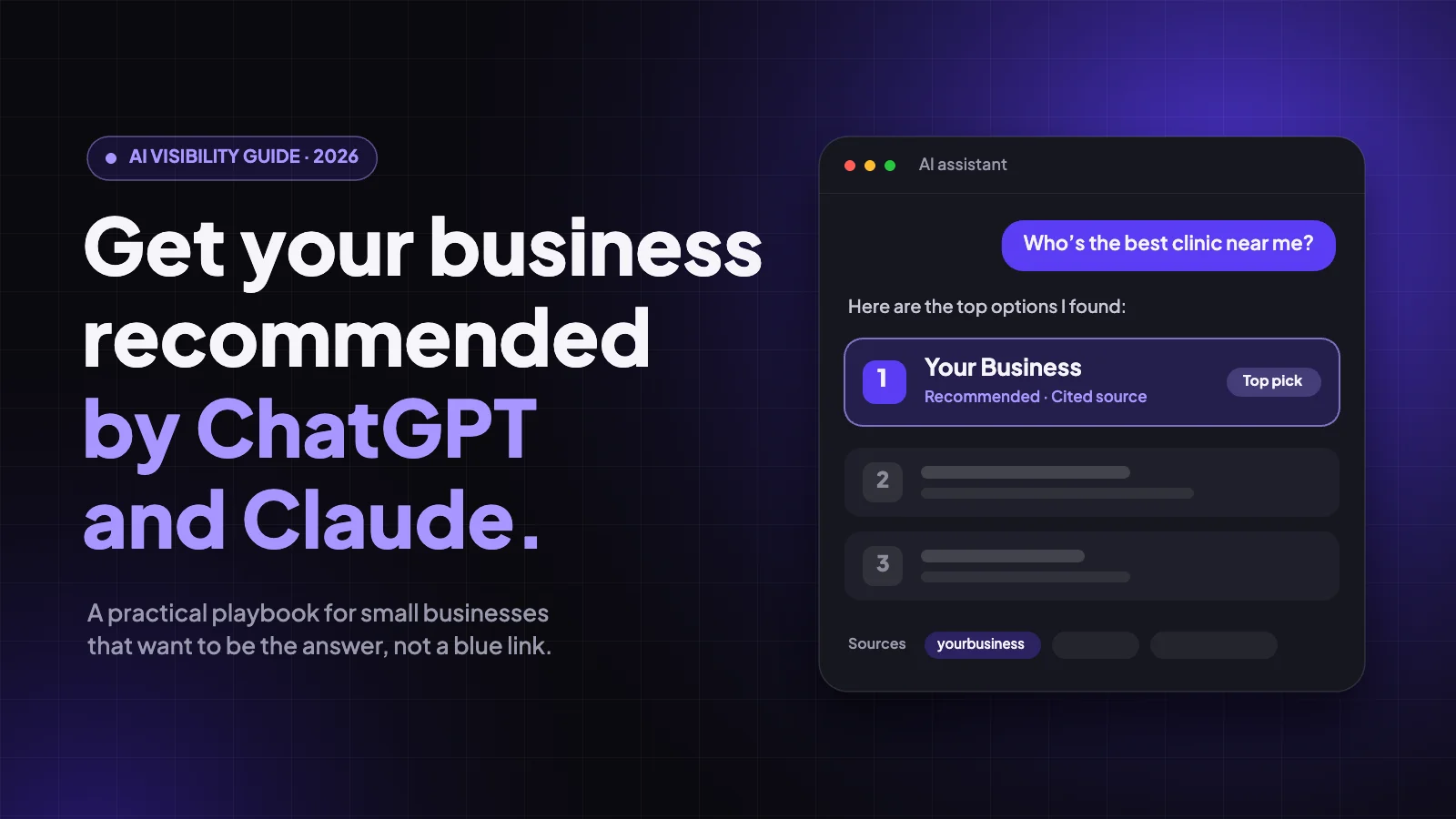
Short answer: AI assistants like ChatGPT, Claude, Gemini and Perplexity recommend the businesses they can find, understand and trust. To get named, your website has to be indexed by the search engines these assistants use, explain clearly what you do and where, answer your customers’ questions in plain language, and be backed up by mentions, reviews and links from other sites. This guide walks through each step, and shows how we took a London clinic from invisible to #1 in ChatGPT in five months.
Why AI recommendations matter now
More and more people skip the list of blue links. They ask an assistant something like “best family dentist in Leeds”, “affordable web designer for a small bakery” or “who does same-day boiler repair near me?”, and they get back a short list of names. If your business is on that list, you get the call. If it isn’t, you never knew the customer existed.
This is often called AI visibility, GEO (generative engine optimization) or AEO (answer engine optimization). Whatever you call it, the goal is the same: to be the business an AI assistant names when someone asks for what you sell.
The good news is that AI visibility is built on solid SEO. You don’t need tricks. You need a fast, well-structured website and a clear, consistent story about your business across the web.
Where AI assistants get their answers
Each assistant answers in two ways: from what it learned during training, and from a live web search when the question needs fresh or local information. Recommendation questions (“best”, “near me”, “top”, “affordable”) usually trigger that live search, which is why being findable in the right search index matters so much.
| Assistant | Where its live web results come from | What to do |
|---|---|---|
| ChatGPT | Bing’s index plus OpenAI’s own crawler (OAI-SearchBot) | Verify your site in Bing Webmaster Tools, submit your sitemap, and don’t block OAI-SearchBot |
| Claude | Brave Search’s independent index | Make sure Brave can crawl and index your pages; strong, clear pages rank well there |
| Gemini & Google AI Overviews | Google’s index and Knowledge Graph | Classic Google SEO, Search Console, and a complete Google Business Profile |
| Perplexity | Its own crawler and index | Allow PerplexityBot and keep pages fast and easy to read |
The takeaway: if you only ever think about Google, you are invisible to part of the AI market. Many small business sites have never been submitted to Bing at all.
The 8-step playbook to get recommended by AI
1. Make sure you can be indexed at all
This sounds obvious, but it’s the most common problem we find. When we started work with The Luna Clinic, the whole site carried a hidden noindex tag and only 2 of its 48 pages were on Google. No amount of content fixes that.
- Check for stray
noindextags and robots.txt rules that block crawlers. - Submit an XML sitemap to Google Search Console and Bing Webmaster Tools.
- Turn on IndexNow (many SEO plugins support it) so Bing hears about new pages within minutes.
- Check that AI search crawlers such as OAI-SearchBot and PerplexityBot aren’t blocked by your host, CDN or firewall.
2. Say exactly what you do, for whom, and where
AI models are pattern matchers. If your homepage says “We craft bespoke solutions”, the model has nothing to work with. If it says “Private fertility clinic in central London offering IVF, egg freezing and fertility testing”, it knows precisely when to mention you.
- Put your service and location in your page titles and main headings.
- Give each core service its own page, built around one primary search phrase (for example “PCOS specialist London”).
- Keep your business name, address, phone number and opening hours identical everywhere.
3. Write answer-first content
Assistants lift short, self-contained passages that directly answer a question. Write the way you’d answer a customer face to face:
- Open each page and section with a one- or two-sentence direct answer, then add detail.
- Use the exact questions customers ask as headings: “How much does a website cost?”, “How long does IVF take?”
- Replace thin pages. Pages under 300 words rarely get cited. At Luna we rebuilt 27 thin pages into 400–600+ words of genuinely useful content.
- Include specifics AI can quote: prices or price ranges, timelines, areas served, credentials.
4. Add structured data (schema)
Schema markup is a label on your page that tells machines “this is a business, this is its address, these are its services, these are its FAQs”. Use LocalBusiness (or a more specific type such as MedicalClinic, Dentist or Plumber), Service, FAQPage and Article where they fit. It won’t rank a weak page on its own, but it removes guesswork for every engine that reads your site.
5. Build topic clusters with internal links
One page about a service is good. A service page supported by several helpful guides, all linking to each other, is much better. It tells search engines and AI that you’re an authority on that topic. Link from your guides to the service page that turns readers into enquiries, and back again.
6. Earn mentions beyond your own website
AI assistants trust what other people say about you more than what you say about yourself. That means:
- Reviews on Google, plus industry review sites relevant to your field.
- Listings in reputable local and industry directories.
- Links and mentions from relevant publications, associations and partners.
- Genuinely useful guides that other sites want to reference.
Quality beats quantity. For Luna we focused on healthcare-relevant links and directories, and referring domains grew from 97 to 2.8K over the engagement.
7. Make your site fast and easy to read
Crawlers have limited time per site. Slow pages, heavy scripts and content hidden behind sliders or tabs all make your site harder to read. Compress images, use caching and a CDN, and keep important text in plain HTML.
8. Test monthly in the assistants themselves
Pick 10 to 20 questions your ideal customer would ask, then ask them in ChatGPT, Claude, Gemini, Perplexity and Google’s AI Mode every month. Note who gets named and which pages get cited. This is the only reliable way to see progress, and it shows you exactly which content gaps to close next.
Real example: from invisible to #1 in ChatGPT
The Luna Clinic is a private fertility and women’s health clinic in London. When we started, it ranked for zero keywords and AI assistants never mentioned it. Over a five-month engagement we fixed indexing, rebuilt thin pages, added clinic and FAQ schema, built topic clusters and earned relevant links. The results:
- #1 in ChatGPT for “best fertility clinics in London”, and #4 for “best IVF clinic in London”.
- 49 pages cited across Google AI Overviews, Gemini and other AI search tools.
- 0 → 1.4K ranking keywords and 5,030 Google clicks in three months.
- 420 patient enquiries: 285 phone calls and 135 form submissions.
Read the full Luna Clinic case study →
How long does it take?
If your site is blocked from indexing, fixing that can show results within weeks. Content, schema and authority work usually takes three to six months to show up consistently in AI answers, depending on how competitive your market is. Local businesses in less crowded niches tend to move faster.
Quick self-check: is your business AI-ready?
- Is your site verified in both Google Search Console and Bing Webmaster Tools?
- Does your homepage say what you do and where, in one sentence?
- Does every main service have its own page with real detail?
- Do you have FAQ content that answers customer questions directly?
- Is your schema markup in place and error-free?
- Are your name, address and phone number consistent across the web?
- Do you have recent reviews and mentions on other trusted sites?
- Have you checked what ChatGPT and Claude say when asked for your service in your area?
If you answered “no” or “not sure” to more than two, there are likely quick wins waiting.
Frequently asked questions
Can I pay to be recommended by ChatGPT or Claude?
No. There’s no way to buy a place in the regular answers of ChatGPT or Claude. They recommend businesses based on what they find and trust on the web, which is why your website and online reputation matter so much.
Is AI SEO different from regular SEO?
It’s built on the same foundation: indexing, helpful content, technical quality and authority. The difference is emphasis. AI SEO puts more weight on answer-first writing, structured data, being indexed in Bing and Brave as well as Google, and consistent mentions of your brand across other sites.
Does a small business really need this?
Small and local businesses often benefit the most. Assistants answer “near me” and “best in [city]” questions with only a few names, and in many local niches the competition hasn’t started optimizing yet.
Do I need a new website to rank in AI search?
Not always. Many sites just need indexing fixes, better content and schema. If your site is slow, outdated or built in a way crawlers struggle to read, a fast rebuild is often cheaper than patching it.
Want AI to recommend your business?
At numanwebs we build fast, affordable websites that launch in days, and we run ongoing AI visibility work that gets businesses named in ChatGPT, Claude, Gemini and Google. Websites start at $199, and the AI Visibility plan is $299/month. See all pricing.
Get a free AI visibility check → We’ll show you where you appear today and what it will take to get recommended. We reply within 1 hour.
Related reading
- Why ChatGPT isn’t recommending your business (9 reasons and fixes)
- How much does a small business website cost in 2026?
About the author: Numan Habib is the founder of numanwebs, a web design and AI SEO studio in Lahore, Pakistan, working with clients worldwide. He builds fast websites for small businesses and helps them rank on Google and get recommended by AI assistants.